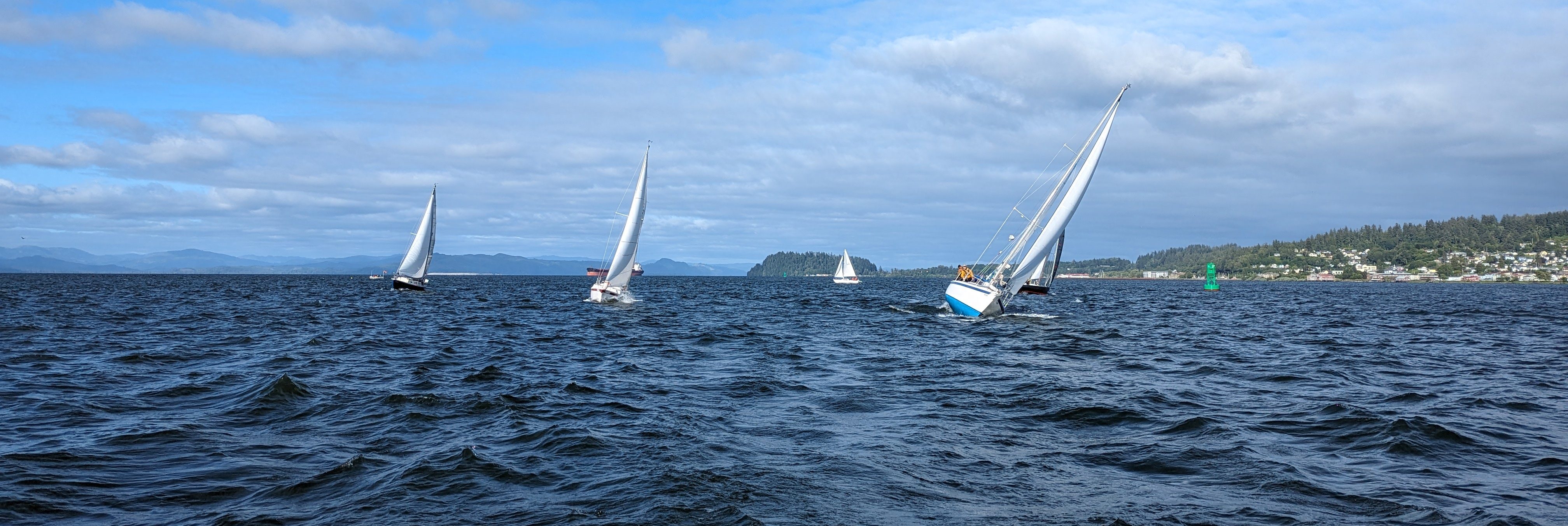
Reporting to you from the US capital, Washington, D.C. Being in DC during Pride Month, Juneteenth and Fleet Week has been a fun, bustling experience. The Wharf waterfront area where we are moored is lined with plenty of great places to eat, drink and watch World Cup matches!
Let’s recap the trip from Seattle, Washington to Washington, D.C. via the Panama Canal.
First, it was LONG. . . 33 days at sea from Seattle to Panama (with two fueling stops along the way) and 14 days at sea from Panama to Washington D.C. We logged 5007 nautical miles (nm) from Seattle to Panama (and 2131nm from Panama to DC).
Second, it was HOT. . . temperatures were consistently in the 90°s (Fahrenheit) (32-35° Celsius) once we got to the Baja Peninsula of Mexico. We were constantly reapplying sunscreen, hydrating, seeking shade, and struggling to sleep. I struggled with a very painful heat rash across my back for many days. For as cold and wet the North Pacific was, the Pacific coastline was hot and sticky, for about as long of a time period.
Third, we were SLOW. . . unfortunately, in the case of both race stages, our plan of attack was ravaged by wind forecasts that didn’t pan out and resulted in multiple wind holes. That left us finishing in 9th place from Seattle to Panama, and 8th place from Panama to DC (we originally finished 9th, but were bumped to 8th after a penalty was assessed to Team Washington D.C.).
Wind holes in the blazing sun are no fun. Most everyone avoided major sunburns and heat issues, so that’s good. It is difficult to stay appropriately hydrated because our water maker strips out all minerals and particulates. Luckily, our team agreed to use crew fund to purchase a variety of hydration / electrolyte supplements. On some boats, they leave it to the individuals to bring their own.
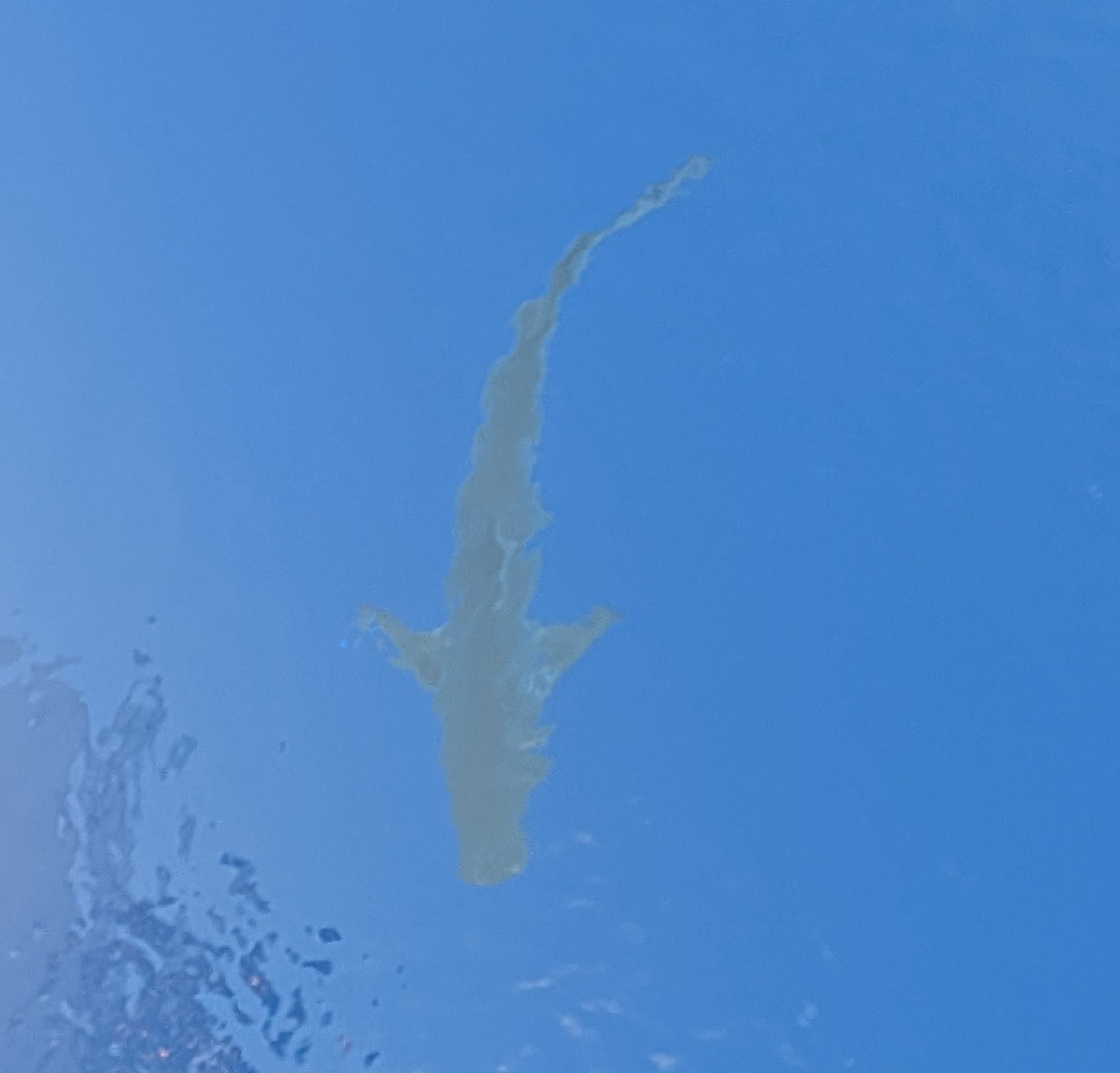
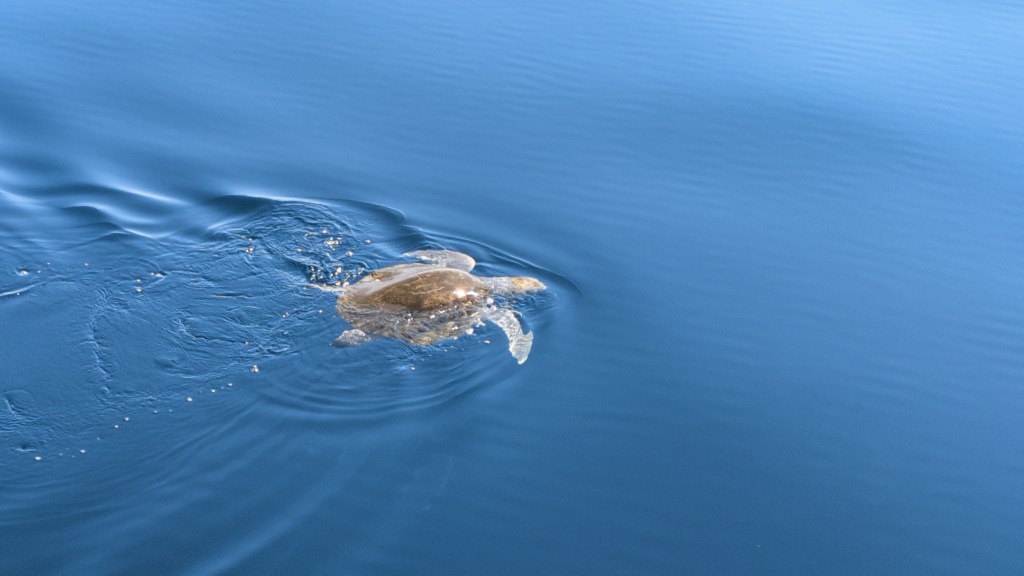
We did witness some neat marine animal activity . . . multiple times, fish such as trigger fish and small jacks used the leeward side of the boat as a sun shade. The water must have been a few degrees cooler as the fish schooled in the shaded water for hours on end. They would eat certain bugs that stayed on the surface of the water, similar to what we call a “pond skipper.” Additionally, we had a shiver of sharks trail behind the stern of the boat for a while. There were up to six at one point! That was maybe one of the coolest things I’ve seen. We also saw a huge congregation of turtles very far offshore. The collective went on for over 15nm. Based upon information we sent to my shoreside support buddy, we surmised that the turtles were Oliver Ridley turtles because of their unique dome shape and wide brim, much like a pith (safari) helmet.
Leg 7 – Stage 10: Seattle to Panama
First, let me thank all my friends and family members that made it to Seattle to pay a visit. We had an amazing celebration at Here Today Brewing near the marina. I was able to take some on a boat tour of Team Scotland. And then, on departure day, I had a lovely and loud outpouring of support from friends and family watching on from Pier 62 – they even made Clipper’s highlight reel (click here / check out the 1:35 minute mark)!
The Doldrums. . . again. During our Crew Brief, it was explained to us that this particular race stage will have us re-enter the Inter-Tropical Convergence Zone (ITCZ) . . . aka The Doldrums. Via NOAA, NASA and Wikipedia online resources: The ITCZ is created where the trade winds from the Northern Hemisphere and the Southern Hemisphere meet. Because the sun is most intense at the equator, it heats up the air and the ocean water below. When the hot, humid air collides with the trade winds, it acts like a hot air balloon and shoots straight up into the atmosphere. Historically, sailors referred to the ITCZ as the doldrums. Because so much air is moving upward, rather than sideways, this zone often lacks surface winds. As a result, sailing ships could get stuck in windless waters for weeks. Me: Can Confirm!
Because the ITCZ was a large component of this race stage, the Race Director placed five possible finish lines along the race route. Depending upon how far the teams get before the majority stall out in the ITCZ, he can call the race at any one of those five finish gates. It turned out we all didn’t make it too far, too fast. So, the race was called at the first finish gate on Day 18 of racing.
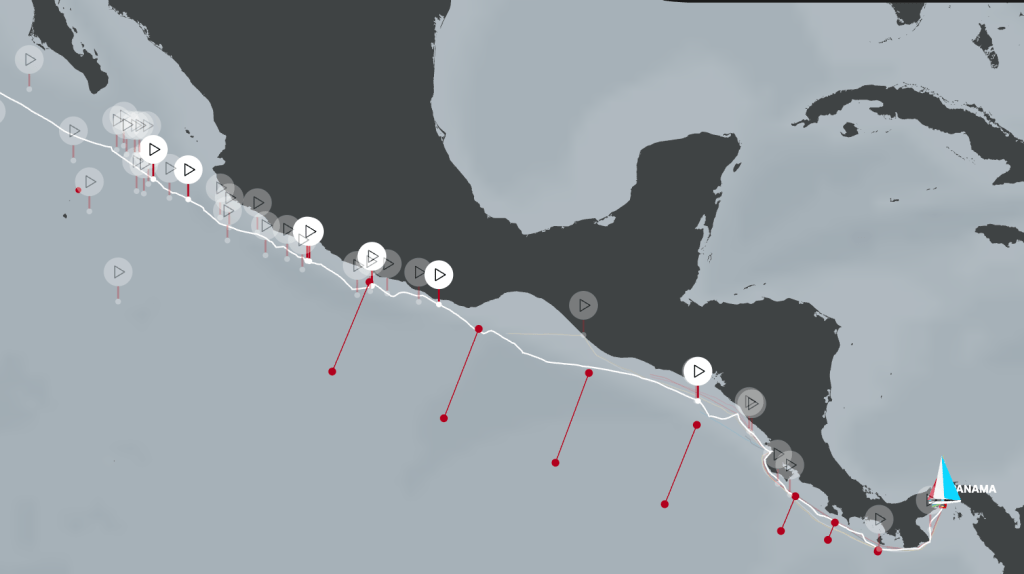
Buddy Boating. Team Scotland and Team Tongyeong both gambled by going further offshore to find the stronger winds. As such, when the race was called at the first finish gate, we had the furthest to travel to get to Panama. We traveled together for 15 days after the race finish. It was good to have Team Tongyeong nearby – both for safety reasons and for cabin fever reasons! We were advised that armed officials from undisclosed Central American nations could potentially board the boat and ask questions about our transit. This happened to other boats in the fleet a couple days prior to our passing the same region. We were never approached or boarded by such officials.
We played “I spy. . .” and pub trivia and shared terrible dad jokes with Team Tongyeong while we motor-sailed with them for over two weeks. When winds were in our favor, we sailed our butts off. When the winds died, we would motor and occasionally tow one another to conserve fuel. Eventually, we made it to Fueling Rendezvous #1 in Puerto Chiapas, Mexico and then zoomed to Fueling Rendezvous #2 in Culebra Bay, Costa Rica. Because we were the final two boats in the fleet to arrive in Panama, it meant we would transit the Panama Canal together on June 1st as well. (more on the canal transit coming in a separate post of its own!)
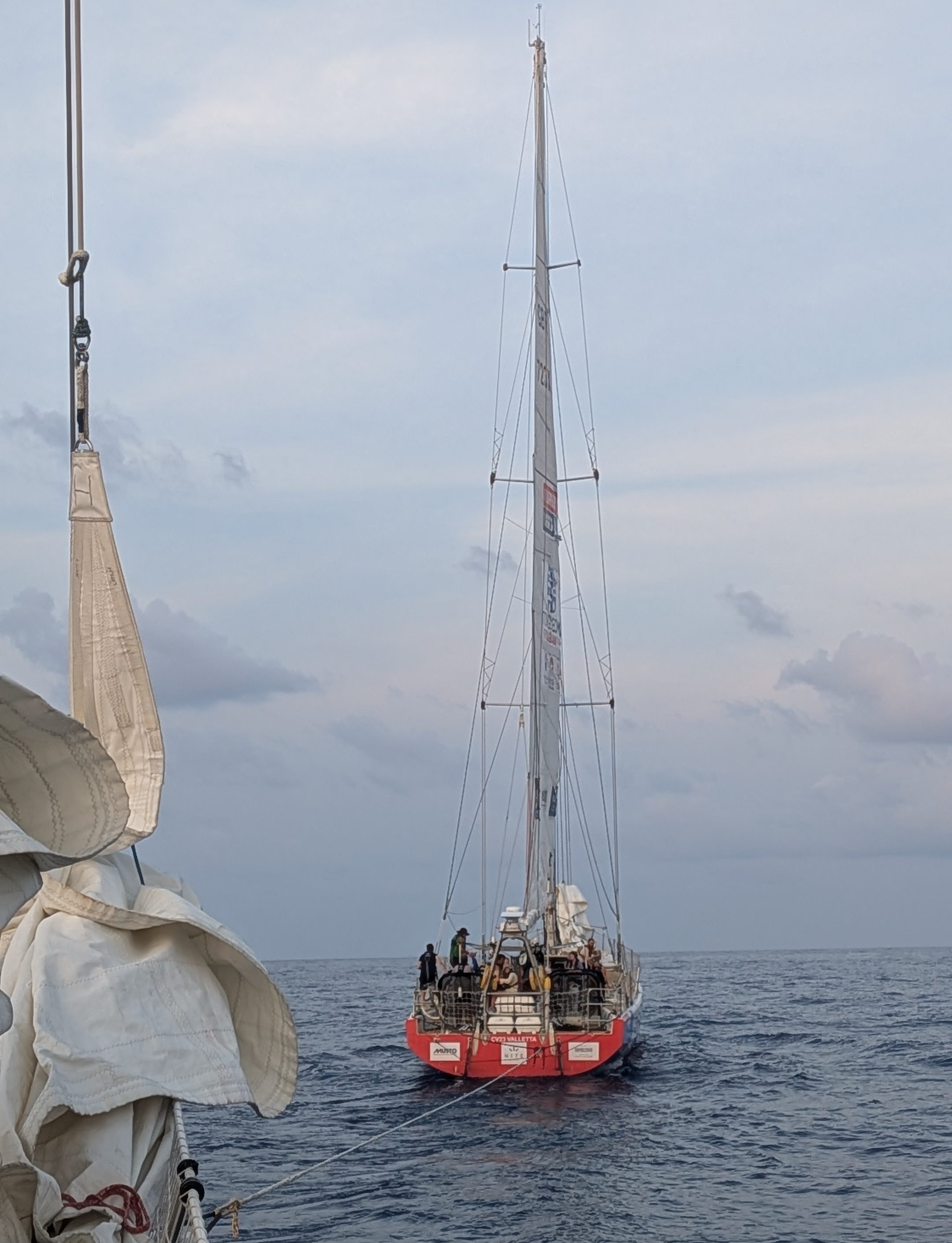

We had an amazing play time session with a few dolphins while being towed by Team Tongyeong!
Leg 7 – Stage 11: Panama to Washington, D.C.
This stage was billed to us as a quick trade winds run up the east coast. We knew that there could be cyclogenic activity. We knew there could be squalls, We knew it would be hot. But no one mentioned more wind holes. We thought we were done with those. Sadly, no.
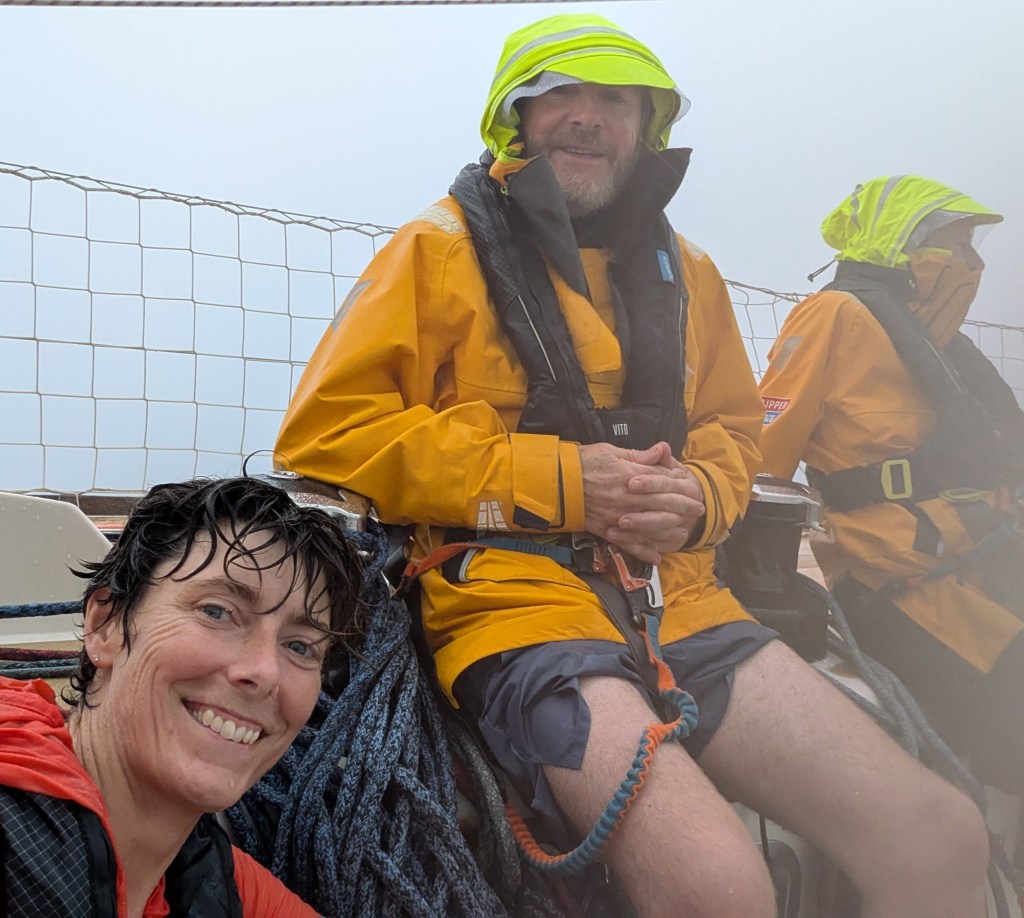
This race stage was unique for so many reasons. It will live on in infamy for its never-ending squalls. At one point, my watch endured 10+ squalls in a 6-hour period. We lost track how many we went through and we lost track how many times we had to reef the mainsail and subsequently shake out that reef. Nowhere else along the race route have we had weather like that.

The race route through the Caribbean meant there were certain waypoints and gates we all had to go through, condensing the pack (kind of like a funnel). Then the race route broke off into a west route and an east route. We took the east route, along with Team LBS, Team DC, and Team Qingdao. Team Punta showed up a few days later and joined our pack. The four of us raced within view of each other nearly the entire race – that hadn’t happened along our year-long race either! It was quite amazing. The four of us would leapfrog each other in any given watch. So, it was tight racing. We never felt out of the running until the last day of the race.
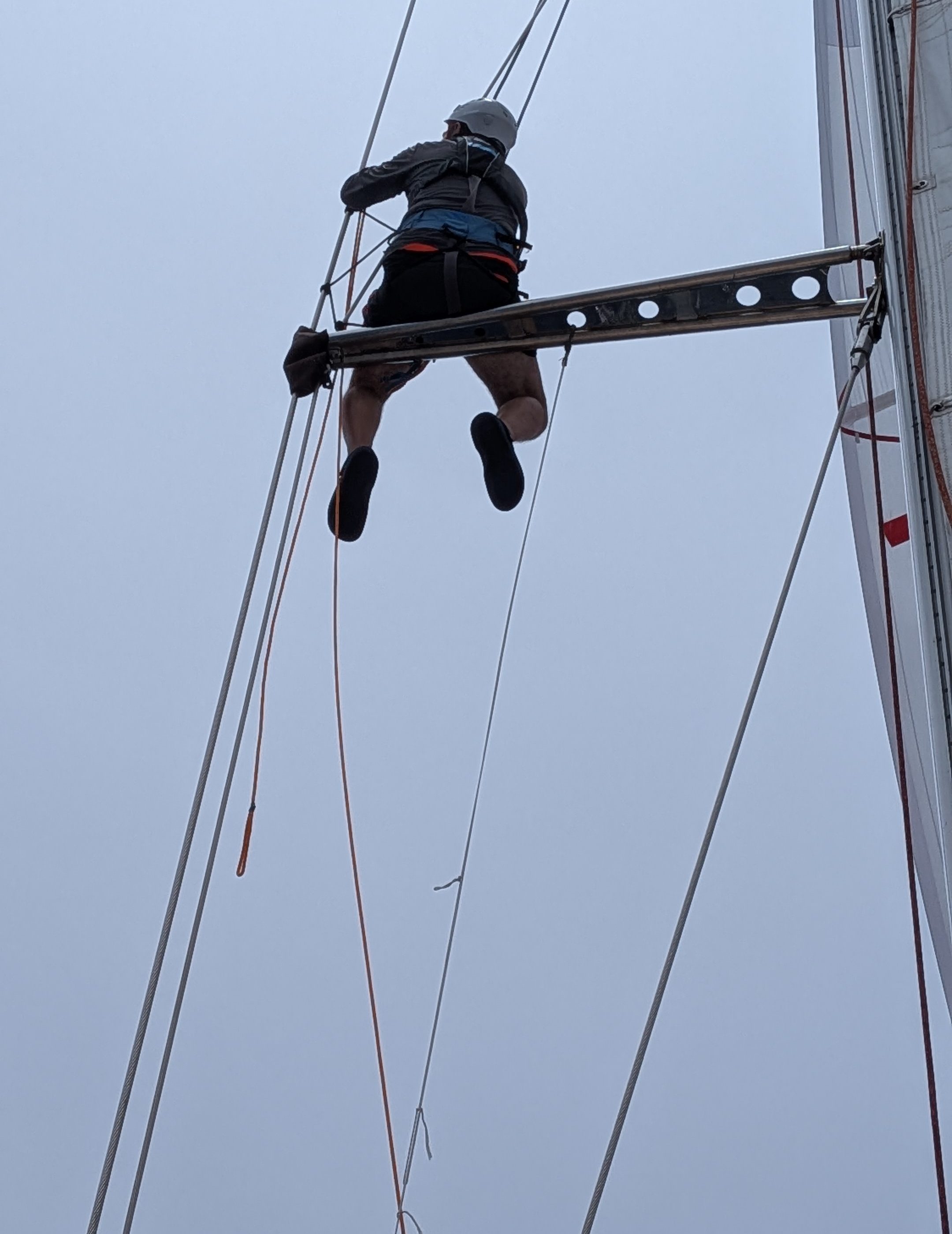
Early in the race, we experienced incredible, intense lightning storms all around us. Some lightning strikes were close to us. We’re unsure why our wind instrumentation (the digital data) stopped working, and even sent First Mate Millie up the mast to inspect for any clear root causes that we could fix. . . but no dice. Our wind instruments were out since Day 2 or Day 3 of the 14-day race. We sailed by the windex (a small arrow at the top of the mast that spins around to tell you the direction of the apparent wind) and the compass. That was it. We didn’t have digital data on wind direction (true or apparent), wind speeds, etc. All those data elements do help us determine our sail plan (which sails to use) and when we need to change things up.
We had a few spinnaker mishaps this race, unfortunately. After a fairly good run without significantly damaging a sail, we managed to behead our Code 1 spinnaker. I think we flew it for too long in too strong of winds and friction against our top spreader caused the sail to tear. My watch was on deck at the time and we called an emergency all-hands-on-deck to recover it and immediately hoist the yankee to keep moving forward.
Prior to the spinnaker ripping, we had two spinnaker halyard mishaps that resulted in all-hands-on-deck to recover the spinnaker. Despite re-tensioning the spinnaker halyard on the hour regularly as advised, the line still snapped.
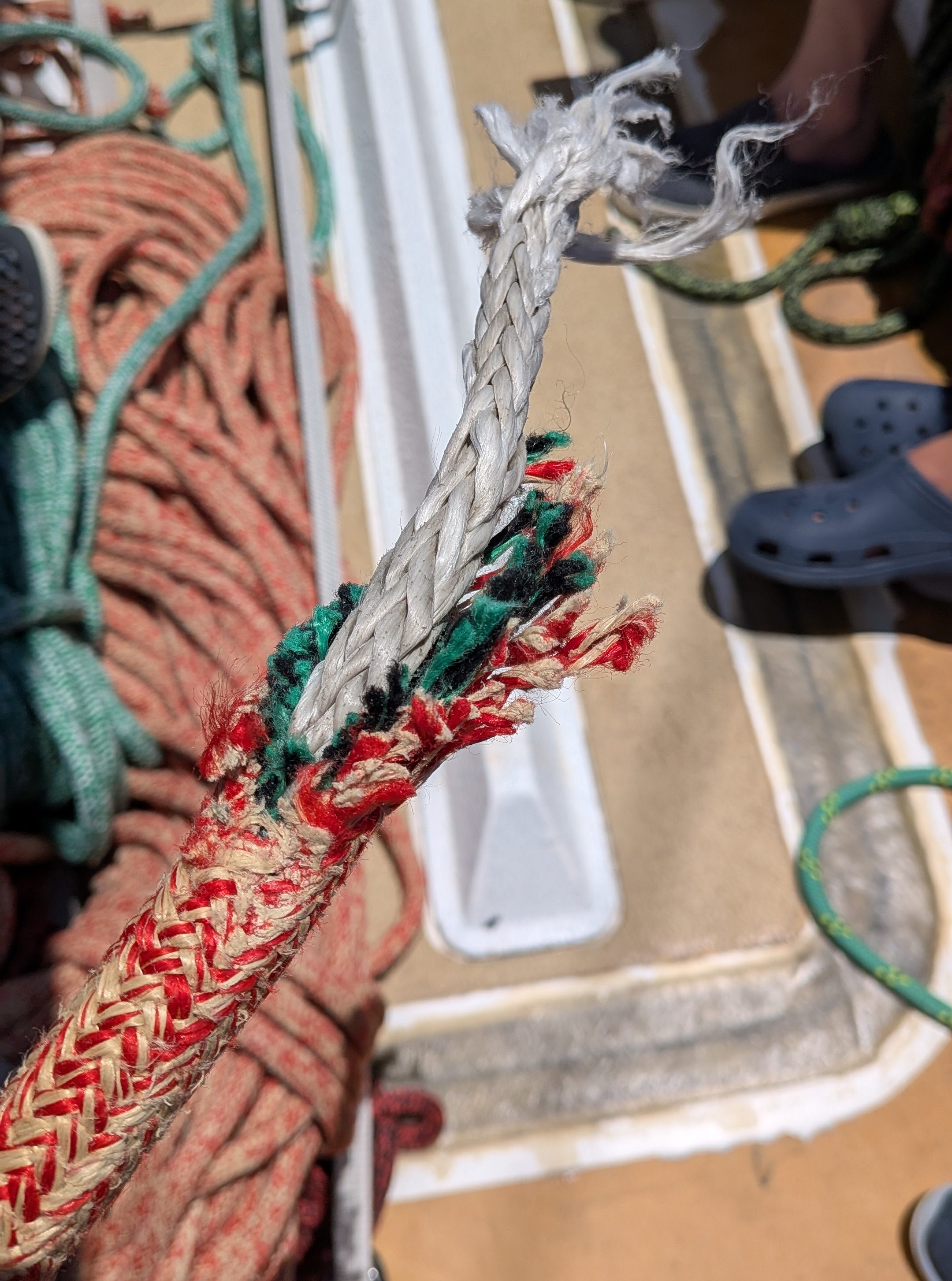
These are all setbacks when racing. Not only do you lose your immediate forward momentum and have to recover as best as possible with a smaller sail in the short term (the yankee), you need to fix the broken line and re-run it up the mast (requiring someone to go up the mast while at sea). And then hope it doesn’t happen again. But it did.
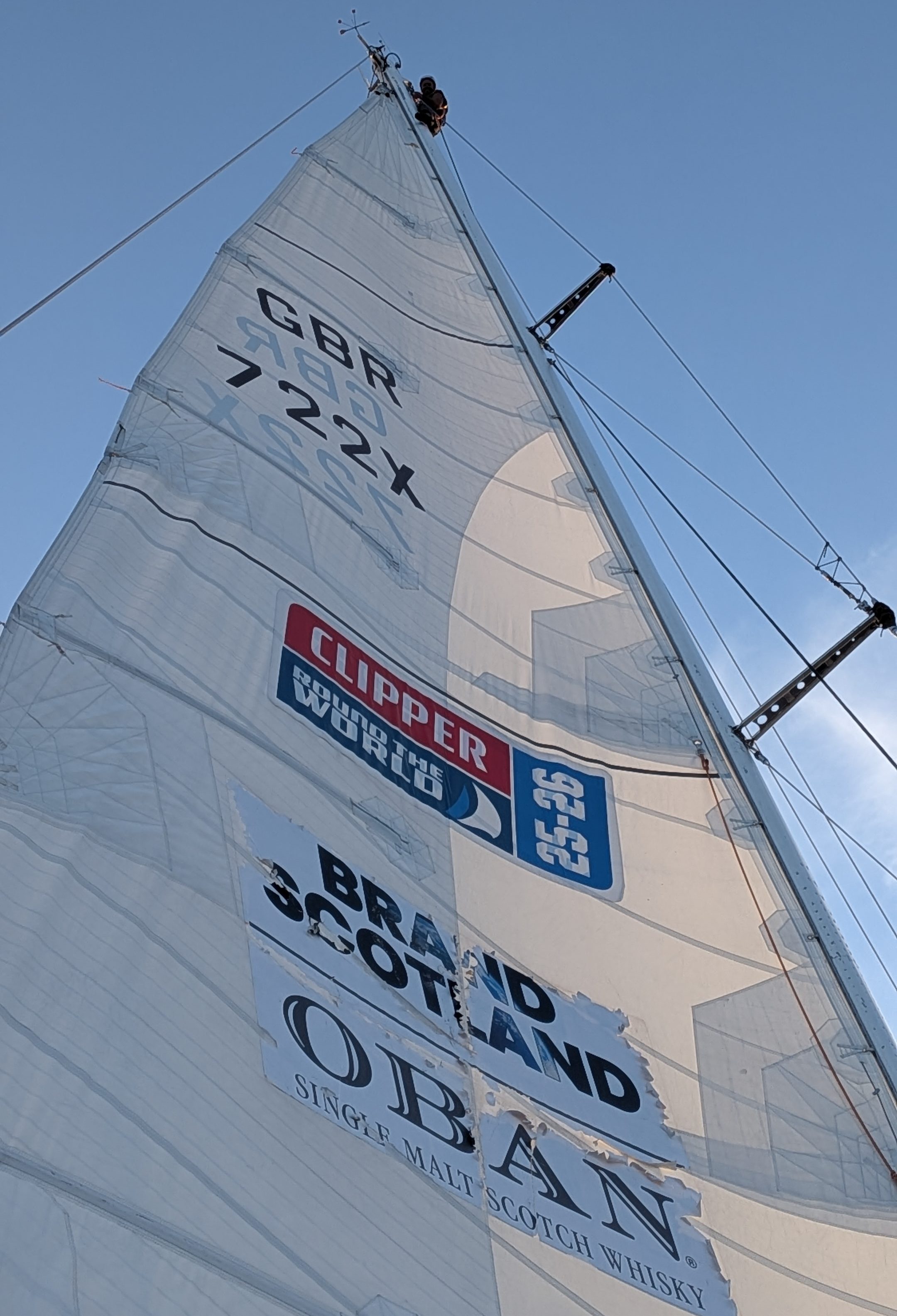
Up until the last 30 hours of the race or so, we were still vying for position with our pack of 4, which became a pack of 5 with Punta zooming in from, seemingly, out of nowhere. (Like, “Oh, hi! Didn’t see you there.”) Sail plan changes, the spinnaker tear, and a few other small mishaps resulted in losing ground on the others that we were never able to fully regain.
We saw a ton of seaweed on this stage, but not a lot of wildlife. That is, until my sister watch reported nearly hitting two pygmy sperm whales! They must have been sleeping on the surface as our boat approached. . .both parties startled, but no one was hurt (whales or humans).
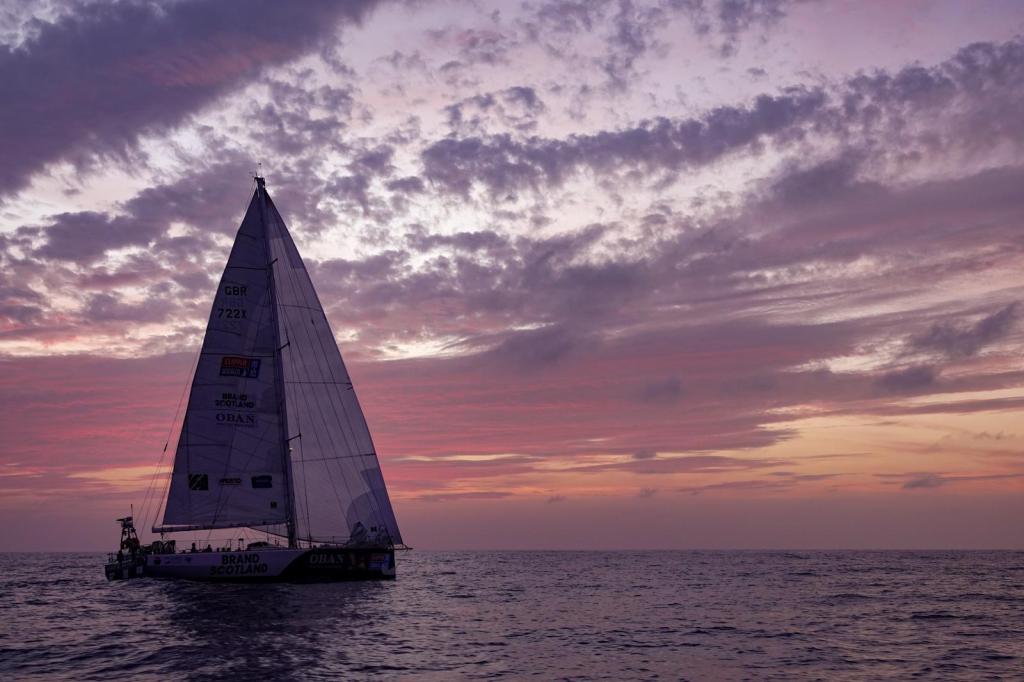
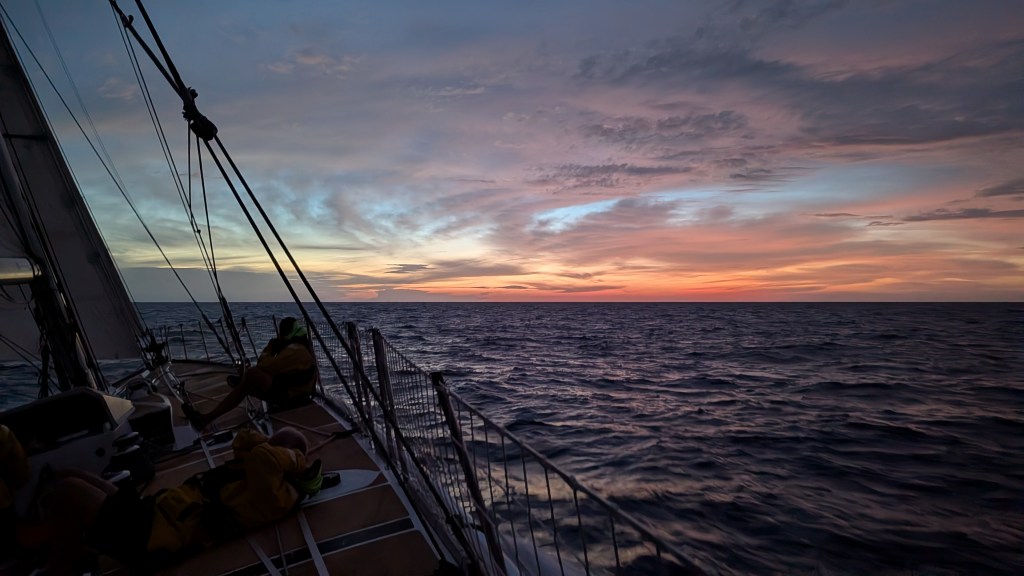
The sunrises and sunsets continued to dazzle. We crossed the finish line near Chesapeake Bay in 9th place the evening of June 15th. We then motored up the Potomac River to Washington, D.C. That was also a neat experience.
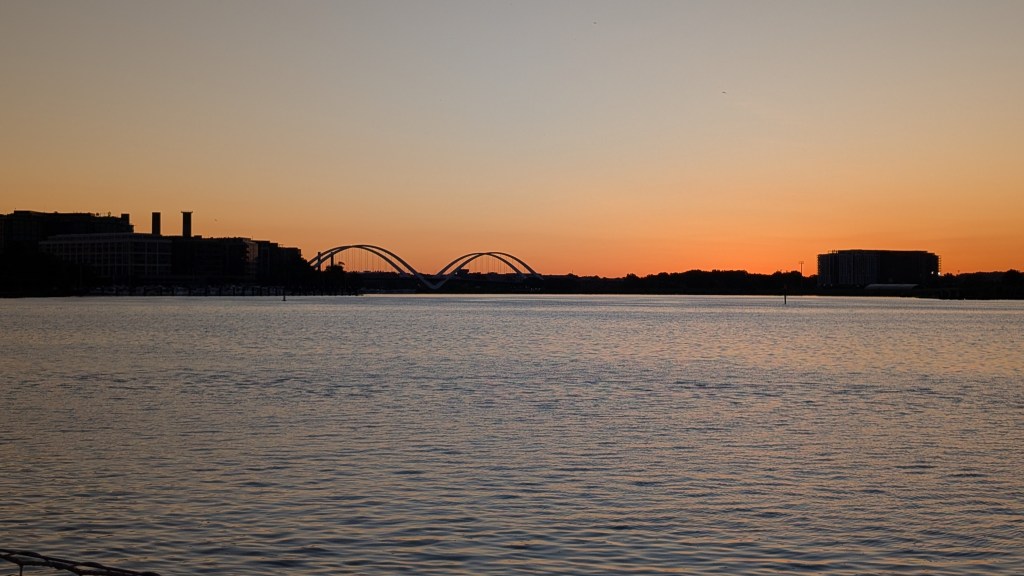
Chesapeake Bay is quite huge – bigger, vaster than I imagined. As is the Potomac River. It is much wider than I imagined and kind of reminds me of the Columbia River back home: the way it meets the ocean and has a brackish color; the width and how that can command its own weather; and, seeing houses dotted along the river’s edge.
The Woodrow Wilson bridge is quite low and a major thoroughfare for vehicular traffic. As such, it doesn’t just magically open when a tall boat comes along. We had to schedule our arrival and bridge opening with their department of transportation. Our bridge opening was scheduled for 04:45 on June 16th. Nine out of the ten boats went through at that time. Because Warrant was so far behind the rest of the fleet, they went through the bridge on the 16th.
Washington, D.C. has been a lovely stopover. The waterfront is vibrant and there are plenty of seasonal celebrations being had this week.
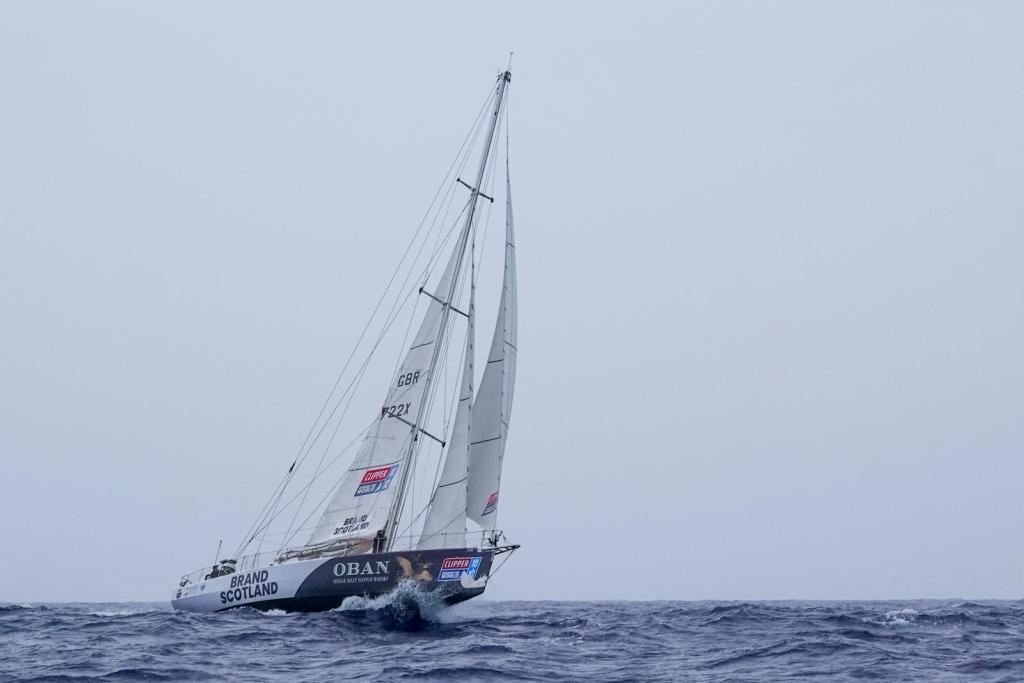
The rest is much needed after 47 days at sea with only 40 hours of rest in Panama. As the race nears its end, I am beginning to think about the “What are you going to do next?” and “What have you learned?” aspects . . . which was always inevitable. But now, folks are really starting to ask. There is no prescriptive next step for me. The learnings are immense and it will take me some quiet time back home on land to process all of them . . . and then figure out what to do with all that. For now, I’m focused on safely and successfully crossing the North Atlantic to Oban, Scotland. And then, completing the finale from Oban back to the race start in Portsmouth, England. Team Scotland is currently in 4th place overall in the race, but we’re aiming for a podium finish in Portsmouth. Onward!


Leave a Reply